


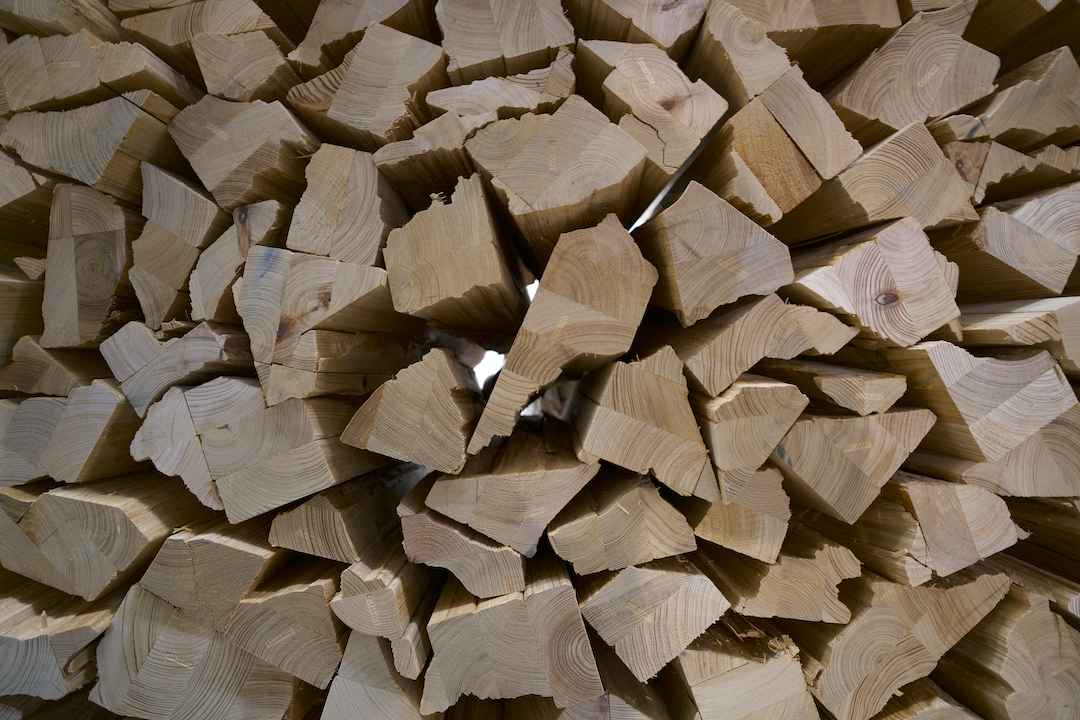


Everglades Cord stacks a cord of split firewood, each log meticulously fabricated from reclaimed cypress lumber reported to have been cut from South Florida swamps before protections on the Everglades. At first glance, it reads as ordinary firewood; closer inspection reveals precision joinery, lines, seams, and also the absences of shaped logs no longer there. As Thoreau noted, wood “warms twice” in the labor of carrying and cutting, and in the burning itself. Here the warmth is abstracted: the stack holds both the labor embedded in its making and the planetary heat released by canopy loss. Both material and meditation, the work registers extraction, transformation, and the cultural logics that turn living trees into lumber and fuel.
-
from the wall text
1) Look
From a distance, this looks like a simple stack of split firewood. Stand here for a while. What do you notice?
When you move closer, you may see that each “log” is built, not split from a natural tree. Look for seams and join lines. The longer you look, the move you see: empty spaces shaped like logs that are no longer there. Look deeper still, and the pile becomes a frame to see the gallery beyond. Step back again, and you now see the firewood as something made, not found.
2) Learn
This stack is made from reclaimed swamp cypress wood stored for many years after a furniture company closed. The lumber is believed to be from South Florida bald cypress cut before current protections for the Everglades banned logging. This wood was purchased legally, and no protected trees were cut for this work. Knowing where the wood came from invites thought about canopy loss, taking, and the long life of trees and swamps.
3) Contemplate
A farmer once told writer Henry David Thoreau that firewood warms you twice, once when you split it, and once when you burn it. This wood has warmed me many times since acquiring it. I have carried it, cut it, joined it, split it, stored it, moved it to the gallery, and soon will move it back to my studio. If it sells, it may keep the heat on. If it doesn’t sell, one day it could warm me as a pyre. The missing trees also warm us in another way, by their absence, less shade, less carbon drawn from the air, more warmth for the planet.
4) Build
These “logs” began as leftover cuts of lumber. In a process of care and respect for material, I shaped and joined these fragments into something whole. I fabricated these objects in a way so that when split with an axe, the edges looked as real as possible. I broke the usual rules for joining wood, choosing to arrange knots and grains in a way that would make each split look more like it came from a living tree. -
TITLE: Everglades Cord
DATE: 2025
MATERIALS: South Florida bald cypress (Taxodium distichum)
SCALE: sculpture
DIMENSIONS: 8’x8’x2’; variable configuration
STATUS: ongoing
OFFERING: Contact with enquiries
-
forthcoming


Pinhole Camera Extension
The apertures formed by the porosity of the stack in Everglades Cord provide conduits for light to scatter across the walls with the dappled light of tree canopy. They also hold the potential to act as a vast pinhole camera. I intend to return this cord of pre-ban Everglades cypress to the swamp from which it was cut, and there capture a single large-format photographic exposure of the tree's remembered forest, using a purpose-built crate which doubles as the camera. Hundreds of interstices between the logs would admit light onto a sheet of wide-format photographic paper, creating a spectral imprint of the swamp: canopy turned image, wood returned to site, memory fixed in emulsion.
The project would yield a unique frame and accompanying artist's proof available for acquisition, and I welcome conversation with those who may wish to partner in realizing this work.